
INSIGHTS
Why Physical Presence Matters More in the Age of AI
September 26, 2026
The more digital the world becomes, the more valuable real-world presence may become.
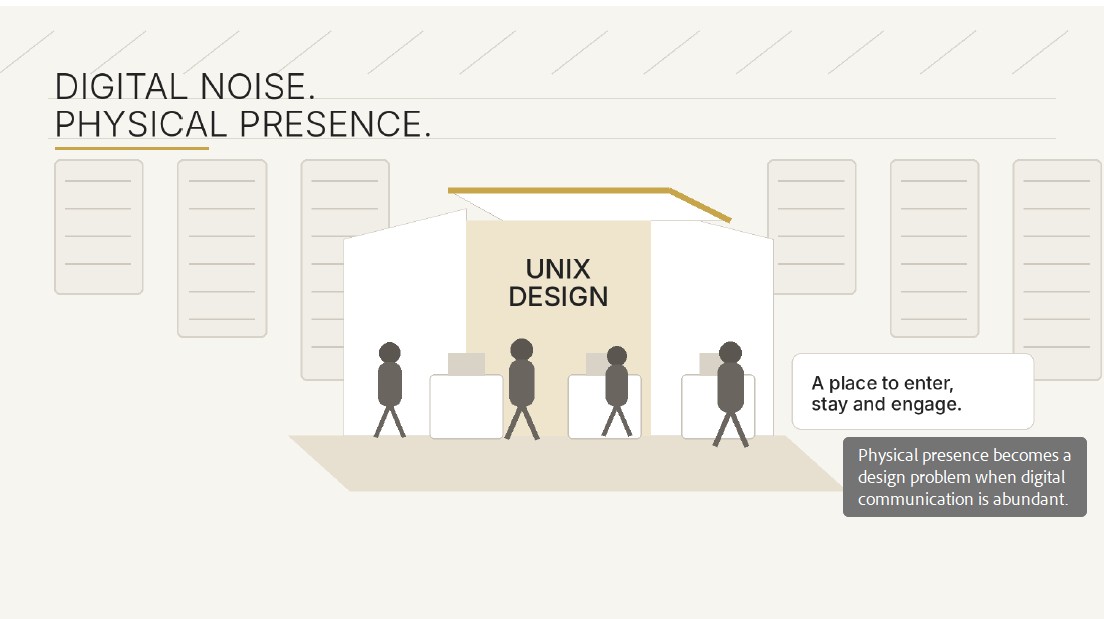
For years, the direction of travel seemed obvious.
More of business moved online. Meetings became video calls. Shopping became a tap. Customer service became a chat window. Marketing became increasingly measurable, automated and personalized.
Artificial intelligence is accelerating that shift.
Today, brands can generate more images, more videos, more copy, more campaigns and more variations of an idea than ever before. What once required days of production can increasingly happen in minutes.
That is an extraordinary increase in creative capacity.
But it creates a paradox.
When digital communication becomes abundant, simply producing more of it becomes less distinctive.
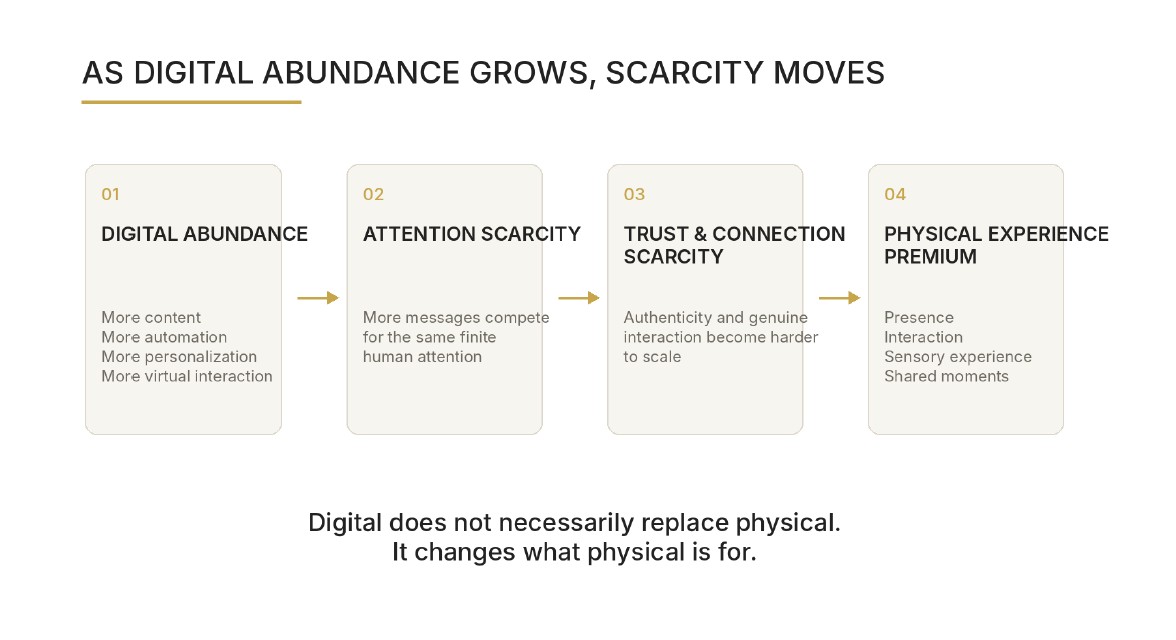
The scarce resources begin to move elsewhere.
Attention. Trust. Presence. Human interaction.
And that shift may make the physical world more strategically important, not less.
From Content Scarcity to Attention Scarcity
For most of modern marketing history, producing high-quality communication was expensive.
Photography required a shoot. Video required a crew. Campaign concepts required significant creative time. Distribution had physical and financial constraints.
AI changes that equation.
The cost of producing another concept, another image or another piece of communication is falling rapidly. The implication is not that creativity becomes irrelevant. It is that volume itself becomes less valuable as a differentiator.
The customer on the other side of the screen still has the same twenty-four hours.
So while content supply expands, human attention does not. This produces a fundamental shift:
For brands, that question extends beyond marketing. It changes the role of physical experience.
When Almost Anything Can Be Generated, Reality Carries a Different Signal
A digital image can show an extraordinary product. A video can create an extraordinary environment. An AI assistant can explain a brand in extraordinary detail.
But none of those interactions necessarily establish that the customer has experienced the product, met the people behind the company or occupied the environment the brand has created.
Physical presence does something different.
You can touch a material. You can test a product. You can notice scale. You can have an unscripted conversation. You can watch other people interact with the brand. You can decide to enter, stay, explore — or leave.
These are not simply offline versions of digital interactions. They are different forms of information.
That distinction becomes more interesting as synthetic media becomes more capable.
The point is not that customers will suddenly stop trusting everything they see online. Nor is there sufficient evidence to claim that AI itself inevitably produces social isolation.[1]
The more defensible observation is simpler: an increasing number of transactions and interactions no longer require people to occupy the same physical space. That changes what physical space has to accomplish.
A Signal From Starbucks: Designing a Reason to Stay
One useful example comes from a business that spent years making the physical transaction easier to avoid.
Starbucks invested heavily in mobile ordering, pickup and digital convenience. A customer can order and pay before entering a store, collect the product and leave with minimal friction.
Yet its current strategy is simultaneously reinvesting in something very different: the coffeehouse as a place to stay.
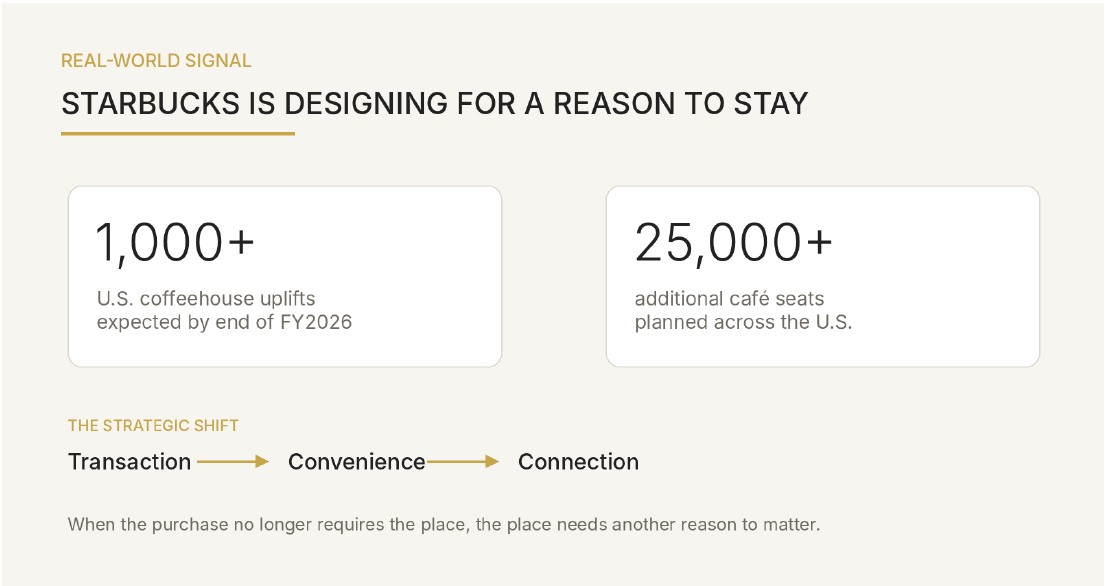
Starbucks says it expects more than 1,000 U.S. coffeehouse “uplifts” by the end of fiscal 2026 and plans to add more than 25,000 café seats across the country. The redesigned environments include softer seating, warmer lighting, improved acoustics, textures and community-oriented spaces. The company explicitly describes the objective as restoring comfort, connection and the role of the “community coffeehouse.”[2]
That matters beyond coffee.
The strategic question is no longer simply: how efficiently can we complete the transaction? The digital layer is already very good at answering that. The physical question becomes:
Starbucks itself argues that convenience and connection do not have to be competing choices.[3] Its investment suggests physical environment can become part of the value proposition precisely when the transaction itself becomes increasingly frictionless.
That is a useful signal for retail, hospitality, commercial interiors — and exhibitions.
The Trade Show Has Always Had to Earn the Visit
There is an interesting reason exhibition design belongs in this discussion.
A visitor walking through a trade show does not have to enter your booth. They can keep walking. They can research your company online. They can watch a product video later. They can scan a QR code. They can contact the sales team from their hotel room.
And they are surrounded by competitors asking for exactly the same scarce resource: their attention.
This makes a trade show booth an unusually concentrated example of the challenge physical environments increasingly face.
What Should a Physical Brand Experience Actually Do?
Good trade show booth design has traditionally been associated with visibility: strong graphics, a recognizable brand, prominent signage and an attractive structure.
Those things still matter. But visibility alone is an incomplete objective. A physical brand environment can perform several jobs that a screen struggles to reproduce simultaneously.
1. Create curiosity
The exterior of the space has to interrupt movement without becoming visual noise. Good exhibition design creates enough information to establish relevance — and enough unanswered information to invite exploration.
2. Change behavior
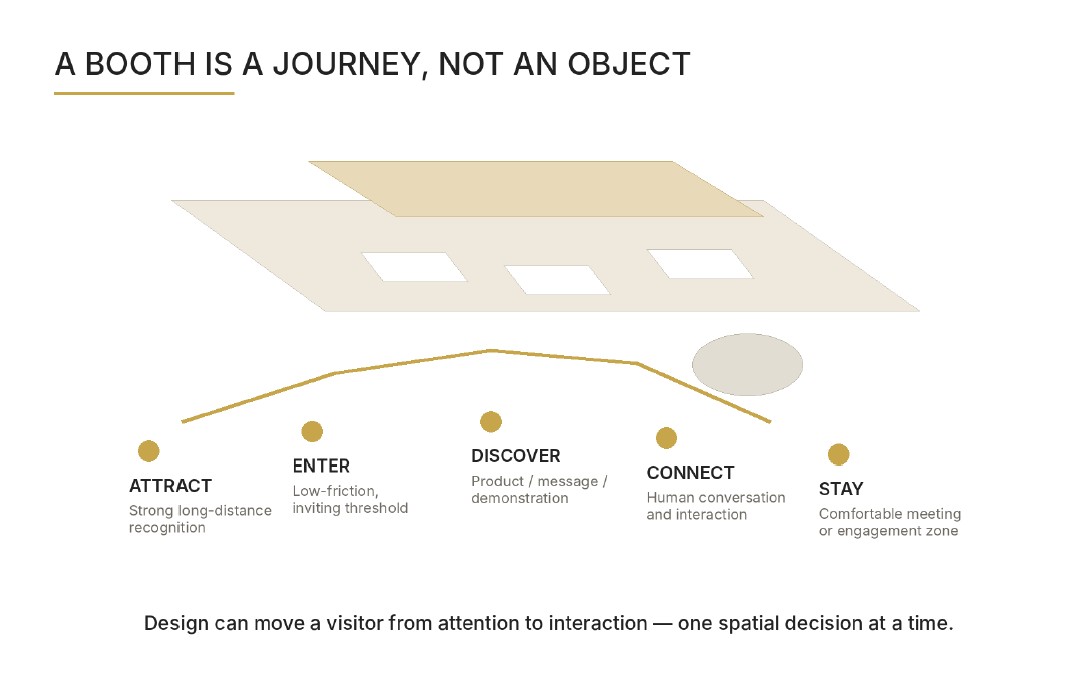
Design determines where people enter, what they notice first, where they slow down, whether they interact with a product and whether a conversation feels natural. The booth is therefore not just an object. It is a sequence of behaviors designed in space.
3. Make the brand tangible
Materials, scale, lighting, acoustics, product placement and spatial proportions communicate attributes that are difficult to express through a brand guideline alone. Precision can be felt. Warmth can be felt. Technical capability can be demonstrated. Quality can become physical.
4. Create human interaction
A booth has an unusual advantage over most marketing channels: the brand and the audience can actually meet. The design should support that interaction rather than simply provide a visual background for it.
5. Give people a reason to stay
This may become the increasingly important measure. Not: “Did they see us?” But: “Did the environment make them want to engage?”
A booth can be designed as a sequence: attract, enter, discover, connect and stay.
The Emerging Opportunity for Physical Brands
There is a temptation to describe the future as a competition between digital and physical. That framing is probably too simplistic. The more interesting model is complementary.
Digital systems are exceptionally good at eliminating friction. They make information easier to access, transactions faster, communication scalable and experiences more personalized.
Physical environments do not have to compete with those strengths. They need to deliver something different.
That is why the renewed emphasis on physical environments seen in businesses such as Starbucks is worth watching.
The physical location is no longer valuable simply because customers have no alternative. Its value increasingly depends on whether people choose to be there.
The Unix View: From Designing Objects to Designing Reasons to Engage
At Unix, we see exhibition environments through this broader lens.
A stand is not successful merely because it looks impressive in a rendering. It has to work in the real world.
It has to attract attention in a crowded hall. Its materials and details have to support the brand it represents. Its layout has to make movement and interaction intuitive. And ultimately, it has to give someone a reason to stop walking and step inside.
This is where exhibition design intersects with a much larger change in physical space.
As more activity becomes digitally possible, the purpose of physical environments shifts. The question is no longer only what a space contains. The question is why someone would choose to be there.
For brands that understand that change, physical presence may become one of their most valuable forms of communication.
Next in the Series
Part II — Execution: The Last Expensive Layer. Why execution matters more when ideas become cheap. AI can generate a thousand concepts. The physical world still has to build one.
Frequently Asked Questions
Why is physical brand experience becoming more important?
As digital content and transactions become easier to produce and access, physical environments can differentiate brands through sensory experience, direct interaction, trust and shared human presence.
How does AI affect trade show booth design?
AI can accelerate ideation and visualization, but the strategic role of a booth remains physical: attracting visitors, supporting product interaction, enabling conversations and turning brand identity into a real environment.
What makes a successful trade show booth?
A successful booth combines clear brand recognition with visitor flow, product or service discovery, interaction areas and practical execution. It should be designed around what visitors are expected to do, not only what they are expected to see.
What is a physical brand experience?
A physical brand experience is the way a person encounters and interacts with a brand in a real environment, such as an exhibition booth, showroom, retail space, event or commercial interior.
Build a Space Worth Entering →
From concept and fabrication to installation, Unix creates exhibition environments designed to turn brand ideas into physical experiences.
Sources: [1] Nature Human Behaviour · [2] Starbucks — 2026 company strategy update · [3] European Business Magazine